Employee Engagement Survey Questions That Actually Predict Turnover
BCS Editorial Team
Enterprise Solutions


(Source: Self-developed)
Engaging employees is very important because it determines organisational performance, productivity, and retention. Engaged employees are committed employees who feel emotionally connected, match the company values, and are encouraged to work towards the success of the company. They become more innovative, customer-oriented, and dedicated, such that the level of job satisfaction increases as well as employee turnover decreases.
Engaged culture helps in open communication, leadership trust, and improvement. Once the employees feel worthwhile and taken care of, they are bound to remain in the organisation, saving the expenditure made on recruiting new personnel as well as maintenance of institutional knowledge. Therefore, a resilient and competitive workforce is dependent on great engagement.
The importance of employee engagement in predicting turnover
- Emotional commitment: When employees are engaged, the feeling can become an emotional commitment because they are emotionally involved with their job and organisation, which will make them more loyal and less prone to looking away.
- Detecting early signs of exit: An employee may appear disengaged to a certain degree that can be identified by signs such as a drop in performance, absenteeism, and low morale, which are evident signs that can lead to turnover.
- Turnover risk identification: Repeated surveying of employee engagement allows recognising potentially high-turnover departments or employees.
- Data-driven decision-making: Engagement information gives insights into workforce sentiment, and HR can make well-informed interventions.
- Root cause analysis: Disengagement can be related to underlying problems such as unrecognised efforts, underdevelopment, ineffective leadership, or communication.
- Timely interventions: Early detection and response to such matters helps decrease the chances of resignation and enhance employee happiness.
- Less cost: Decreasing turnover will reduce recruitment, onboarding, and training costs and save institutional memory.
- Optimised retention program: With the help of predictive engagement data, organisations will have the opportunity to construct custom retention programs.
- Morale and stability of teams: A good workplace culture brought about by engaged employees leads to a considerable improvement in morale and minimises group turnover.
- Sustainable performance: Since engagement is viewed as a turnover indicator, it leads to a loyal, productive, and long-term workforce.
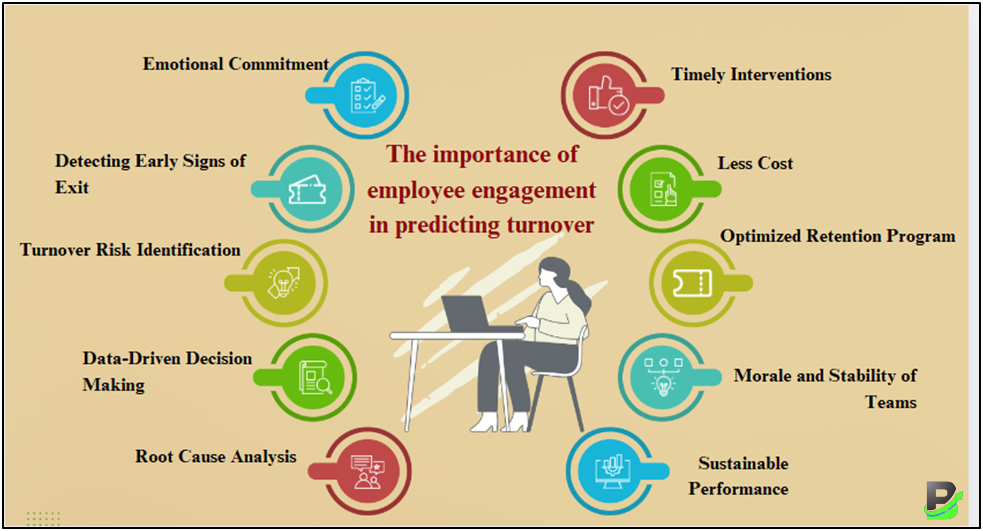
(Source: Self-developed)
Predictive Survey Questions
Predictive surveys will assist organisations in becoming proactive in their people management by asking predictive questions. The survey questions are:
1. How satisfied are you with your company as a place to work?
- Very dissatisfied
- Dissatisfied
- Neutral
- Satisfied
- Very satisfied
2. How satisfied are you with the present position and duties?
- Very dissatisfied
- Dissatisfied
- Neutral
- Satisfied
- Very satisfied
3. Why do you think of leaving this organisation?
- Lack of career growth
- Poor work life balance
- Low pay or benefits
- Poor management
- A better prospect elsewhere
- Other
4. What do you think about the feedback received about your performance?
- Not helpful at all
- Rarely helpful
- Neutral
- Usually helpful
- Always helpful
5. Who do you turn to for support when you're facing challenges at work?
- Manager
- A colleague and team member
- HR or support staff
- I handle it alone
- Other
6. How frequently do you get to feel appreciated in your work?
- Never
- Rarely
- Sometimes
- Often
- Always
7. What was the last time you felt engaged at your job?
- Within the past week
- Within the past month
- Over a month ago
- Can’t remember
- Never
8. What career development opportunities have you experienced within the last year?
- Training and workshops
- Mentoring and coaching
- Promotion or new role
- None
- Other
9. How manageable is your current workload?
- Very unmanageable
- Unmanageable
- Neutral
- Manageable
- Very manageable
10. Why do you feel proud (or not) to work for this organisation?
- Mission and value
- Culture and people
- Pay and benefits
- I don’t feel proud
- Other
11. What are the chances that you will seek alternative employment in the next 6 months?
- Very unlikely
- Unlikely
- Neutral
- Likely
- Very likely
12. What might we do to increase the possibility that you might remain?
- Provide higher promotion opportunities
- Enhance communication within the management
- Pay more or pay bonuses
- Offer greater flexibility in hours
- Recognize employee success more often